

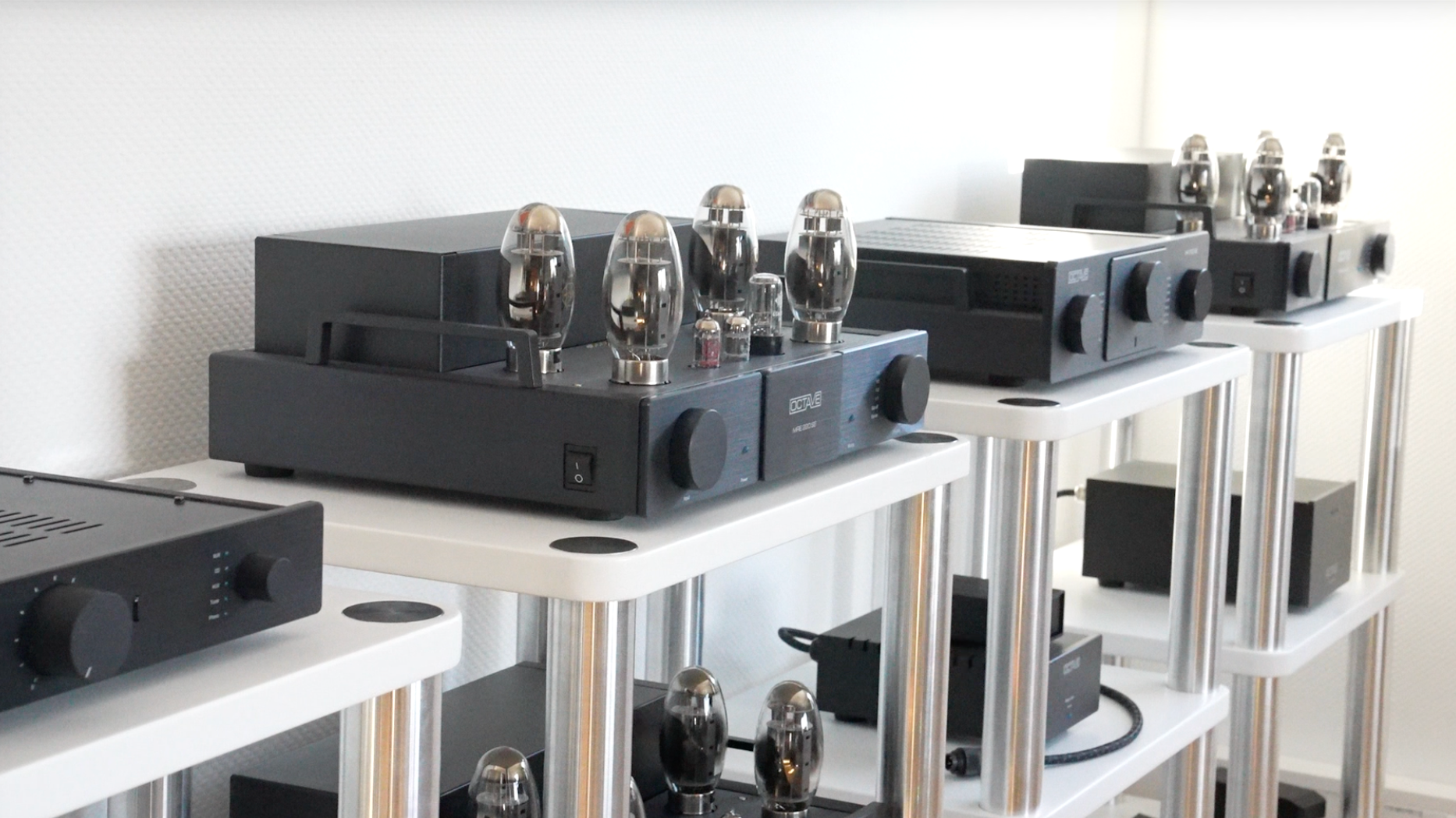
On January 29, we invite you into something rare. Octave: Three Rooms. One Truth. is an intimate listening event at Definitive, focused on what tube amplification can deliver when it is engineered without compromise.
There are moments when music is reproduced so convincingly that the room goes still. Conversations fade. Attention sharpens. Something deeper takes hold. For Andreas Hofmann, founder and chief designer of Octave Audio, that moment has always been the goal. Not impressive specifications or technical theater, but the instant when sound turns into feeling.
Our curiosity around Octave runs deep. So deep, in fact, that we sent a member of the Definitive team to Germany to visit the Octave factory, sit down with Andreas, and spend time understanding what truly drives his approach to tube amplification. What follows is not a technical manifesto, but a story of obsession, discipline, and a refusal to compromise on what music is meant to feel like.
You can watch the full interview with Andreas here, but we wanted to share the heart of that conversation with you.
When the Numbers Weren’t Enough
Andreas did not begin his career as a tube evangelist. Like many engineers coming of age in the late 1970s and early 1980s, he initially gravitated toward transistor-based designs. Operational amplifiers were improving rapidly, high power was easier to achieve, and development paths were clear.
But something didn’t sit right.
Through his interactions with serious classical music listeners—people deeply familiar with live, unamplified sound—Andreas noticed a recurring pattern. Many of these listeners paired transistor power amplifiers with tube preamplifiers. And as reluctant as he was to admit it at first, those tube preamps consistently sounded more convincing.
That realization became a turning point.
With the help of his father, an electronics engineer from the original tube era, Andreas began developing a tube preamplifier that addressed what he saw as the weaknesses of traditional tube designs. He wanted silence, bandwidth, control—without sacrificing the tonal beauty that made tubes special. The result was the HP 500 preamplifier, introduced in 1986 and later recognized as a reference component by Stereoplay. It remained in production for over a decade and laid the foundation for everything that followed.
From that moment on, Andreas committed fully to tube technology—not out of nostalgia, but because it proved capable of delivering something transistors alone could not.
The Obsession That Never Changes
When asked what he cannot let go of when developing something new, Andreas’ answer is unwavering: emotional truth.
He remains in constant contact with music lovers who know sound in its original form. He attends concerts and opera performances. And inside Octave, every new product is evaluated by a team of discerning listeners who understand that musical realism is not about exaggeration or effect.
A new model is only considered complete when nuance, intention, and feeling come through clearly—when the music moves you, not just impresses you. If that standard is not met, development continues.
The Moment Octave Almost Didn’t Happen
One of the most defining chapters in Octave’s history came through a challenge that many designers avoided.
Andreas set out to build tube power amplifiers that could preserve musical beauty while delivering enough power and control to work with modern loudspeakers. Push-pull designs were the only viable option—but they came with well-known sonic compromises. Ultra-linear circuits were widely accepted as superior, while pentode designs were often dismissed outright.
Andreas refused to accept that assumption.
Over several years, he developed a push-pull pentode concept paired with specially designed output transformers. The result was greater naturalness, improved stability with complex loudspeaker loads, and a sense of authority that had previously been elusive in tube amplification.
The proof came quickly. Early products like the V 50 integrated amplifier and the MRE 120 monoblocks were met with critical and commercial success. That technology became the backbone of Octave’s lineup—and today, it reaches its highest expression in the Jubilee Ultimate power amplifiers, where dynamics, control, and musical sovereignty coexist without compromise.
The DNA That Defines Octave
From day one, Octave has stood for something rare in the world of tube amplification: ease of ownership.
Andreas was determined to build tube amplifiers that were reliable, stable, and intuitive to live with. No ritualistic warm-up sequences. No compatibility headaches. No fear of thermal runaway or tube failure turning into catastrophe.
Octave preamplifiers feature exceptionally low output impedance, making them compatible with a wide range of systems, including transistor amplifiers. Power-on and power-off sequences are electronically managed. Units can run continuously for days or weeks. Fluctuations in mains voltage are handled gracefully. Power amplifiers incorporate robust monitoring systems that protect both the unit and the tubes themselves.
This philosophy—what Andreas calls “power management”—is not an add-on. It is fundamental. And it is why Octave amplifiers deliver consistent sound quality year after year, without the anxiety that often accompanies tube ownership.
Perfection, for Octave, is not just about sound. It’s about everything around it.
Partnership With Purpose
When Andreas speaks about working with Definitive, the conversation shifts from business to values.
He sees alignment in standards, in care, and in the way we approach the listening experience. For us, Octave is not simply another brand—it is a meaningful addition that opens new interpretations of what high-end audio can be.
That mutual respect is what allows systems like the Octave Jubilee platform to exist not as showpieces, but as deeply musical tools.
No Easy Shortcuts
Asked where he refuses to compromise, Andreas smiles.
The answer, he says, is everywhere.
If a feature is difficult to implement, he looks for another way—but the end result must remain unchanged. Performance, reliability, and musical truth are non-negotiable. Anything less simply isn’t Octave.
Why This Matters
Spending time with Andreas Hofmann reinforces something we believe deeply at Definitive. Extraordinary sound does not come from chasing trends or leaning on nostalgia. It comes from clarity of purpose, long-term thinking, and an obsession with how music makes us feel.
That philosophy lives inside every Octave amplifier. And after seeing it firsthand—inside the factory, inside the circuits, and inside the listening room—we’re proud to bring that experience to you.
Because when it’s done right, tube amplification doesn’t ask for attention.
It earns it.
Share:
Let's Remember the Why
When Tubes Disappear and Music Takes Over