

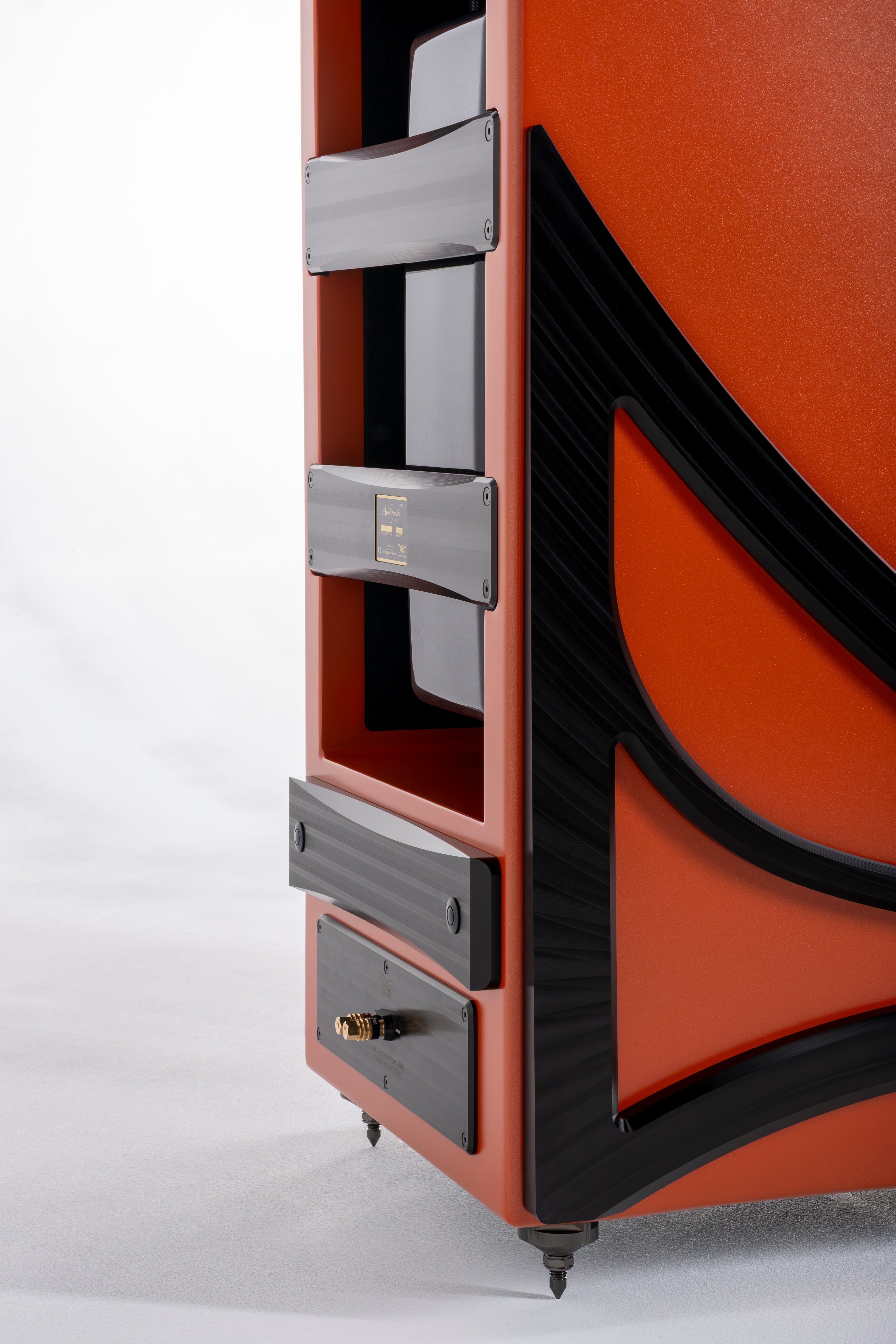
One Day Early But It's Here
https://publuu.com/flip-book/37290/2438671
All the Specs are here.
Here's what Sean had to say:
They’re calling it Autobiography. 1,800 hand-assembled pieces per channel. Every one of them carries 52 years of Wilson Audio inside it. Aluminum. X-material. V-material. Stainless steel. A little gold. Each chosen because it does one thing better than anything else in the world.
Years earlier, Dave had told his son what the work was about. What he loved in it. Don’t hold back.
Daryl carried it into development.
So they didn’t.
Flat frequency response isn’t the hard problem anymore. Good measurement gear gets you there.
Time is the hard problem. Time is what almost nobody solves.
The Autobiography solves it faster than any of their previous models.
Below the threshold. Above the argument.
821 pounds per channel. A new 15-inch woofer. A new 12-inch woofer. A 7-inch quadromagnetic midrange. A 2-inch upper midrange whose internal architecture can only be built by SLS laser sintering. A tweeter module that moves independently of the upper gantry. All of it in service of one thing… Time.
After a factory tour we drove up to Dave’s listening room. When they designed the house, Dave asked one thing of his Sheryl Lee (his partner in business and life). This is my room. Do what you want with the rest. She did. He built this.
Thirty feet wide. Forty feet deep. Sixteen-foot ceiling. Double sheetrock, glued and screwed. A cathedral for listening. The first Autobiography to leave the factory now lives in it.
Daryl opened with a Japanese recording of a pencil writing on paper. Because the speaker’s name is Autobiography. That’s what writing sounds like when you’re close to it.
Then a recording Michael Stearns made on a plateau in Venezuela. The same plateau Pixar used for Up. Birds thirty-five feet to the left. Fire crackling somewhere behind you. The room dissolved.
Peter played a Mahler 3rd he’d recorded himself. Boston Symphony, 1993. He was on the orchestra’s board then. He bought the bass drum. He’d heard the recording on the WAMM in Munich, on XVX demos all over the world. He said Saturday was like… the first time.
Then Blackbird. Originally mono, later split to stereo. A flawed recording from 1968. The air around McCartney’s voice felt like a room you could walk into.
The bass pressurized the space below 15 hertz without a subwoofer. In a room this size, that is not supposed to happen.
Halfway through a track, someone said it without being asked.
The most coherent product this company’s ever made.
Coherent is the word. When every driver arrives at the same instant, your brain stops assembling a speaker and just hears the performance. A room. A pianist. A voice.
Daryl is pretty sure no manufacturer in the world could reproduce the Autobiography. Not even given the time. One pair takes a full day in a single paint booth. Every part passes through two or more hands. The first one off the line has to match the last one on the floor, and will.
We’re bringing it to Seattle.
The four notes that suddenly mean something different don’t announce themselves. They just land.
UPDATE as of April 21st

Not much to share yet, as we were sworn to secrecy, but trust me when I say what I heard was something on a level that I never knew was possible.
-Sean
UPDATE as of April 19th
A reflection from Sean.
There are things that find you before you're ready for them.
A line in a film. A note that shifts something. A room you walk into not knowing what's about to happen.
Tomorrow I'm in Utah.
Daryl Wilson will be there. In person. Presenting what fifty years of obsession looks like when it finally becomes a loudspeaker.
Then the factory. Then we sit down and listen.
I've been writing about time for the last few weeks — in film, in music, in the way sound has to arrive at exactly the right moment or the whole thing falls apart.
The world finds out about the Wilson Audio Autobiography on April 24th.
You'll experience it in June.
Tomorrow is where all of that starts.
— Sean

UPDATE as of April 16th
Wilson Audio Autobiography — Time Alignment & Port Design
Wilson has always built loudspeakers around time-domain correctness. The Autobiography takes that further than anything they've made before — including the WAMM Master Chronosonic and the Chronosonic XVX.
Both the upper and lower PentaMag midrange modules are independently adjustable via Wilson's module alignment sled system. The MTM crescent frame is similarly equipped. Every sled gear, alignment indicator, and reference scale is calibrated for precision and readable with a simple turn of the rotating cam grip. It's the kind of setup hardware that makes the difference between a speaker that performs and a speaker that performs for your room, your listening position.
The port design is equally considered. In forward-firing configuration, output in the 10–75 Hz region is reduced by approximately 1.0–1.5 dB while 75–130 Hz increases by 1.5–2.0 dB — a tighter, more controlled low end. Flip to rear-firing and the response inverts, offering more bass energy and room-boundary flexibility. Two speakers. Infinite room solutions.
This is not adjustment for its own sake. It's precision-engineered to disappear into whatever room you put it in.

UPDATE as of April 14th
New Photo released showing off the Acoustic Diodes.
And here's what we know so far....
Wilson Audio Acoustic Diode
Most isolation feet are an afterthought. The Wilson Acoustic Diode is not.
Built from Wilson's proprietary V-Material — the same composite they developed for their speaker cabinets — paired with austenitic stainless steel, the Acoustic Diode is engineered to do one thing: stop the cabinet from talking back. Vibration goes in. It doesn't come out the other side. That's the point.
The result is a quieter, more resolved presentation from whatever component you place them under. Less hash, more information. The kind of difference that makes you wonder what you were missing before.
Specifications
- Materials — Proprietary V-Material & Austenitic Stainless Steel
- Height — 2 1/32" – 2 17/32" (5.16 – 6.43 cm) adjustable
- Diameter — 2 5/16" (5.87 cm)
- Weight — 12 oz (0.34 kg) per unit · 8 units per box
- Thread Sizes — Standard ½"-13 · Additional sizes available: ⅜"-16, 5/16"-18, ¼"-20, M6, M8, M10, M12
- Finishes — Natural Stainless Steel · Carbon Black
Small parts. Serious engineering. Exactly what you'd expect from Wilson.

Some rooms change you. You walk in not knowing what to expect, the music starts, and something shifts. You stop thinking about the gear. You stop thinking about anything. There's just the sound, and then there's you, and for a few minutes, the distance between those two things disappears entirely.
We've been lucky enough to build a lot of those rooms. But a large number of them — the ones you remember for years — happen because of Wilson Audio.
April 24th, 2026, is one of those moments. The global launch of the Wilson Audio Autobiography. And Definitive is one of only seven dealers in the world chosen to welcome the newest addition to the Wilson lineup.
This is the story of how we got here. And why it matters.
2017: A Room Full of People Who Didn't Know What Was Coming
Music Matters is our annual event. It started as a way to bring clients, music lovers, and curious audiophiles together around the thing that actually drives all of this: the music. Not the specifications. Not the finish options. The music.
In 2017, Wilson Audio asked us to host the world premiere of the Alexx.
The Alexx was Wilson's new flagship at the time — a full-range, five-driver, four-way loudspeaker built on everything Wilson had learned in four decades of design. It was a serious piece of engineering and a serious piece of furniture. At 263 pounds, it had a physical presence that announced itself before you'd heard a note.
We set up the room. We invited our clients. We didn't over-explain what was going to happen.
Then the music started.
“The thing about a world premiere — a genuine one, where the product hasn't been in a magazine yet, hasn't been reviewed, hasn't been talked about in forums — is that people come in without preconceptions. They just listen.”
What they heard that night was the Alexx doing what great Wilson speakers have always done: putting you in the room where the recording was made. Not a facsimile of it. Not an approximation. The actual space — the ambience, the air, the distance between the musicians. The kind of imaging that makes you stop and look to your left because you're certain there's something there.
That premiere was a statement of trust. Wilson Audio trusted us with it. Our clients trusted us to make it worth their evening. We'd like to think we delivered on both.
What Wilson Audio Actually Does
Before we get to the Autobiography, it's worth saying clearly what Wilson Audio is — because the audiophile world has a habit of mystifying things that are actually quite rational.
Wilson Audio builds loudspeakers around a single obsession: time-domain correctness.
Most loudspeakers compromise on time alignment. The tweeter fires first. The midrange follows. The woofer lags behind. The result is a presentation that is technically correct in terms of frequency response and technically wrong in terms of everything else. Instruments smear. The soundstage collapses. The sense of a real acoustic space disappears.
Wilson solves this by physically positioning each driver so that the acoustic output from every driver arrives at the listening position at the same moment. The enclosures are modular and adjustable. The geometry is calculated per installation, per listener height, per room. It's not a feature. It's the reason Wilson speakers sound the way they do.
Add to that their cabinet materials — X-Material and V-Material, Wilson's proprietary composite structures, developed in-house, engineered for specific resonance profiles — and you have a loudspeaker where almost nothing is left to chance.
“You're not hearing Wilson Audio. You're hearing the recording. Everything that was laid down in that studio, played back with the kind of fidelity that makes you understand why the engineers spent three days getting the microphone placement right.” -Sean Skelley
That's the design philosophy. The Autobiography is where it reaches its fullest expression yet.
The Autobiography
Daryl Wilson has been shaping loudspeaker design since he took over from his father, David, in 2012. The Autobiography is, as the name suggests, personal.
Wilson describes it as the culmination of everything the company has learned — not an incremental update, not a new flagship built to occupy a price tier, but a genuine attempt to make the best loudspeaker Wilson Audio has ever produced. The name itself is deliberate. This is a statement about who they are and what they've spent fifty years figuring out.
The engineering reflects that ambition.
The Autobiography is a four-way loudspeaker — tweeter, upper midrange, lower midrange, woofer — with a cabinet architecture that has been entirely reconsidered from the ground up. The enclosures are built from Wilson's latest iteration of their proprietary composite materials, tuned to eliminate cabinet-induced colorations at a level beyond anything they've attempted before. Every panel, every joint, every volume — all of it calculated to stay out of the music's way.
The crossover network uses Wilson's most advanced component selection process, with each capacitor, resistor, and inductor measured and matched in-house. It's the kind of attention to detail that doesn't show up in the specifications but absolutely shows up in the listening.
And then there's the time alignment. Taken further than the Alexx. Further than anything in the Wilson line. The result — from everyone who has heard it — is a front-to-back, left-to-right, floor-to-ceiling sense of space that isn't just impressive. It's disorienting in the best possible way.
Our unit: Crowned Rose finish. Black grille. Silver and Natural hardware.
It is, as far as we're concerned, extraordinary.
Why Seven Dealers
Wilson Audio is careful about who represents them at launch. They choose dealers who have demonstrated the ability to do three things: set up the speaker properly, pair it with electronics worthy of it, and present it to customers who will actually hear what it can do.
That's a shorter list than you might expect.
We've been a Wilson Audio dealer for years. We set up every Wilson speaker we sell. We don't hand you a manual and wish you luck. We come to your room, we adjust the positioning to your space and your listening height, and we don't leave until it's right. We know what these speakers need because we've done it enough times to know when it's right and when it isn't.
If you're coming in to hear the Autobiography — whether you're considering owning one or you simply want to know what the world's best speakers sound like — you're going to hear it at its best in our Experience Center. That's the only way we know how to do this.
Stay tuned for more info as we find out more as the speaker Wilson has been crafting for 51 years comes to life.
Share:
The Barco We Saw Coming
The Other Half of the Equation: Dan D'Agostino Momentum C2Z Preamplifier